Search toggle
Say hello.
Focus Str. 5th Ave, 98/2 34746 Manhattan, New York
+1 222 44 55

Why Real Briefings™ Exist

Peer-Reviewed Research

Land use regulations increase housing prices by 40% to over 2,000% — dwarfing the impact of income growth, population growth, or interest rates.

A study of 250 major U.S. cities — including five Washington cities — found that land use regulations add far more to housing prices than income or population growth combined. In high-regulation metros like Seattle, regulatory costs account for the majority of the price premium over construction cost.

In Bellingham, land alone accounts for approximately $250,000 of a $600,000 home — 42% of the total price — a premium driven by zoning and land use restrictions, not construction costs or demand. Seattle ranks among the highest in the nation for this "zoning tax" on land values.

Eicher, T. — Journal of Economic Analysis, UW (2023)  ·  Gyourko & Krimmel — "Impact of Local Land Use Restrictions on Land Values" — NBER (2021)
START
  1. 1
    Layer 1: Growth Management Act

    It Starts at the State Level

    Washington's Growth Management Act (1990) concentrates all development inside Urban Growth Boundaries. Before any local decision is made, the state has already defined where housing can and cannot exist.

    Enacted 1990 — still the master constraint See the briefings
  2. 2
    Layer 2: Comprehensive Plans

    Plans That Sit on Shelves

    Every county and city must produce a Comprehensive Plan to guide 20 years of growth. Our research found less than 5% of what's written in these plans is ever acted on. The gap between the plan and reality is where the housing crisis lives.

    < 5% of plan commitments are acted on See the briefings
  3. 3
    Layer 3: Local Land Use Rules

    Zoning Decides What Gets Built

    Minimum lot sizes. Setbacks. Height limits. Parking minimums. Single-family-only zones. Each rule, written over decades with no cumulative accounting, reduces the number of homes that can legally exist on any given parcel.

    $250K of a $600K Bellingham home is land cost See the briefings
  4. 4
    Layer 4: Planning Department Review

    Months Become Years

    Even a compliant project faces design review, environmental review, neighborhood notification, and conditional use permits. A project that should take 6 months to permit routinely takes 2–3 years. Every month adds carrying cost that gets priced into rent.

    6 months → 2–3 years, routinely See the briefings
  5. 5
    Layer 5: Building Fees

    The Hidden Tax on Every Home

    Impact fees. Connection fees. Building permit fees. Wastewater fees. School district fees. In Whatcom County jurisdictions, these fees total $40,000–$80,000 per unit before a nail is driven — charged by multiple agencies with no single entity accountable for the combined total.

    $40K–$80K per unit in fees alone See the briefings
  6. 6
    Layer 6: Construction Costs

    Where Everyone Looks First

    Labor, materials, contractor availability — these are the costs everyone sees. But by the time a builder reaches this step, five layers of policy have already shaped what's financially possible. Construction costs are the visible tip. The other five layers are the iceberg.

    The last layer — not the root cause Browse all briefings

You Have Arrived

Unaffordable Housing

End of the Road

This is the predictable outcome of six layers of policy — designed at different levels of government, in different eras, for different purposes — none ever reconciled with each other.

Traditional subsidies — vouchers, tax credits, rent assistance — cannot offset what policy builds in. Without fixing these six layers, they are "sand castles before the tide." — Metcalf, Journal of Economic Perspectives (2018)

Real Briefings documents every decision, at every layer, in real time.

Public Transparency

BR

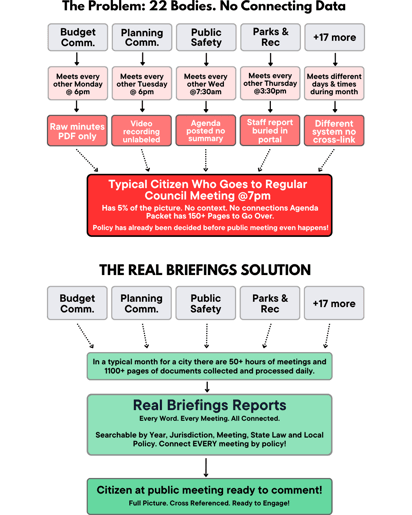
Public meetings are a foundational element of transparent government. In theory, they provide residents with direct access to how decisions are discussed, debated, and made. In practice, however, that transparency often breaks down.

Most residents cannot attend multiple public meetings each week. People have jobs, families, and obligations that make consistent attendance unrealistic. Even for those who do attend, the experience is often incomplete: documents referenced during meetings may not be publicly available, may be released after the fact, or may exist across multiple agendas, staff reports, and committees. As a result, understanding the full context of a decision—what led to it, who advocated for it, and what alternatives were considered—is difficult, if not impossible.

Compounding this problem is the fragmented nature of modern local government. Related topics are frequently spread across multiple committees, commissions, and council meetings, each operating on different timelines. A discussion introduced in one meeting may quietly resurface months later in another, sometimes with materially different outcomes, assumptions, or conclusions. Without a structured record that connects these dots, accountability erodes—not because decisions are hidden, but because they are dispersed.


Compounding this problem is the fragmented nature of modern local government. Related topics are frequently spread across multiple committees, commissions, and council meetings, each operating on different timelines. A discussion introduced in one meeting may quietly resurface months later in another, sometimes with materially different outcomes, assumptions, or conclusions. Without a structured record that connects these dots, accountability erodes—not because decisions are hidden, but because they are dispersed.

Real Briefings exist to close that gap.

Real Briefings systematically capture, summarize, and organize public meeting information so residents can clearly understand:

  • What was discussed
  • Who said what
  • What decisions were made
  • How those decisions connect to prior meetings, documents, and commitments

Each briefing creates a permanent, accessible record of public decision-making—one that does not disappear with a meeting adjournment or get buried in agenda archives. We track topics across time, follow up on unresolved issues, and ensure that decisions have a clear public trail from introduction to outcome.

Our goal is simple but essential:
to ensure that no decision exists without context, no policy change without a public record, and no unresolved issue without follow-up.

Headshot small size

Real Briefings are not advocacy pieces or opinion summaries. They are a civic infrastructure—designed to help residents stay informed, institutions remain accountable, and public trust be grounded in clear, verifiable records of how government actually operates.

Brian Gass, Executive Director

We want you to Learn, Connect, and Contribute. 

Explore the Briefings

See how public decisions actually unfold—what was discussed, what changed, and what was decided.

View Latest Briefings

Follow the Record

Get updates when issues resurface, policies change, or decisions move from discussion to action.

Subscribe for Updates

Help Close the Loop

Know of a meeting, document, or decision that needs follow-up? Tell us what to track next.

Submit a Tip or Topic
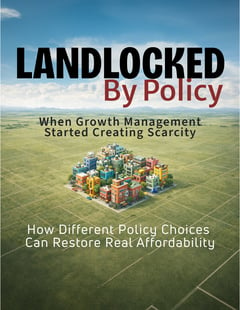
LANDLOCKED6

Why America's housing crisis is no accident

Exposes how the Growth Management Act and local regulations create artificial land scarcity that drives housing costs to crisis levels.

Reserve your FREE copy today!