


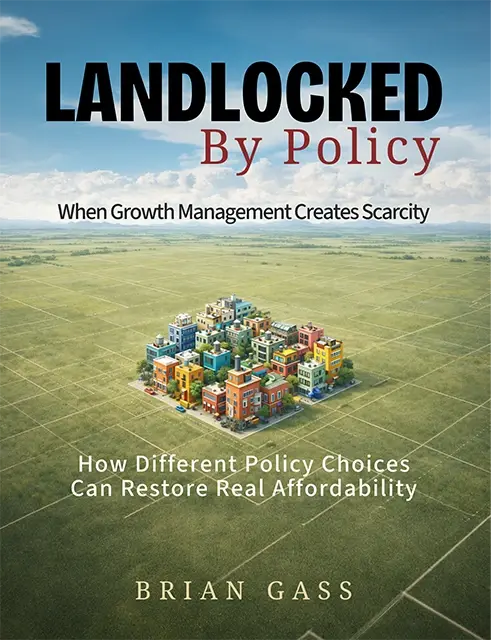
It's not personal.
It's policy.
Washington's housing crisis wasn't caused by market forces, population growth, or greedy landlords. It was built — deliberately — through thirty years of regulatory decisions. This book names them.
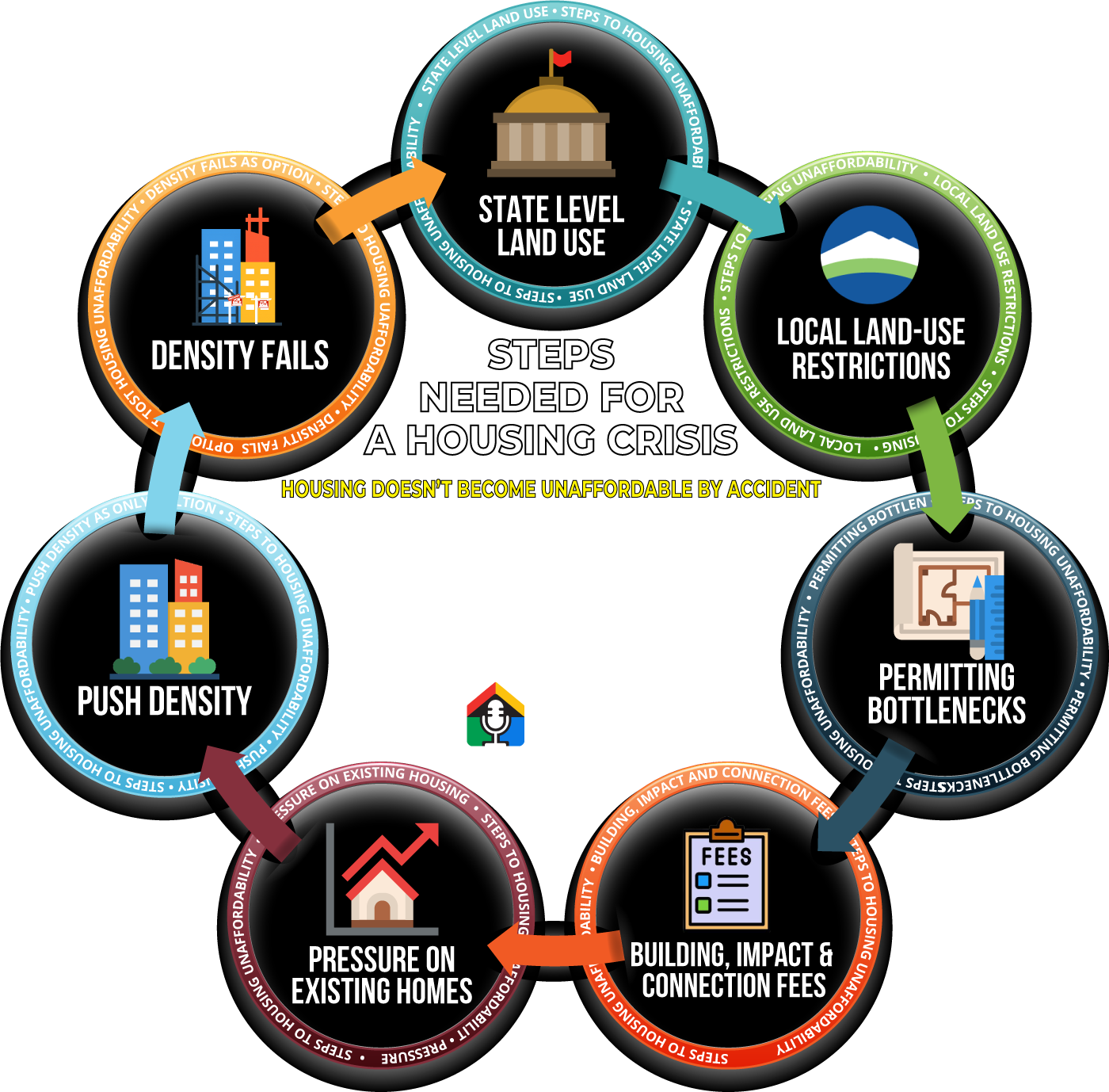
Housing didn't become unaffordable by accident, nor did it happen overnight.
For decades, housing affordability has been framed as an inevitable consequence of growth, demand, or market forces beyond anyone's control. But across high-cost regions, a different pattern has quietly emerged.
As land use rules narrowed where homes could be built — and which types were allowed — scarcity became policy, not coincidence. Starter homes disappeared. Entry points closed. Costs rose, not because land ran out, but because choices did.
LANDLOCKED by Policy examines how growth management shifted from guiding development to constraining opportunity — and how those constraints shape prices, rents, commutes, taxes, and the real financial choices people can make about work, family, and stability.
Importantly, this book does not stop at diagnosis. It introduces the Income Covenant Model, a practical framework designed to reconnect housing costs to income, expand access to ownership, and restore affordability without relying on subsidies, speculation, or price controls.
- How the Growth Management Act became permanent scarcity by 2025
- Why Bellingham went from $165K homes in 1998 to $626,896 today
- The 7-step cycle every Washington city is now caught inside
- Why density alone makes housing more expensive — not less
- The Income Covenant Model: workforce homeownership without subsidies
- How to verify every claim in the book through realrecord.org
The only city outside California in America's top 15 most unaffordable small cities.
I've lived in Whatcom County since 1979. Bought my first home in Bellingham in 1998 on a working income. Watched, over the next twenty-five years, what happened next.
This book uses Bellingham as the case study because it's the city I know best — and because the data says Bellingham isn't merely struggling. It is, by a national ranking, the most unaffordable small city in the United States. The fourteen cities immediately behind it are all in California. Bellingham's nearest Washington competitor — Bellevue — is at rank 28.
Whatcom County also leads Washington in severe renter cost burden: 28.7% of renter households here spend half or more of their gross income on housing — the highest rate in the state's major rental markets.
What's happened in Bellingham is the trajectory every Washington city is on, just at different distances from the same destination. That's why this is the case study. Not because it's worst, but because it's first.
- 01 Bellingham, WA 12.0×
- 02Alhambra, CA11.8×
- 03Mountain View, CA11.5×
- 04Tustin, CA11.1×
- 05San Mateo, CA10.9×
- 06Union City, CA10.7×
- 07Fullerton, CA10.6×
- 08Inglewood, CA10.6×
- 09–15All California cities10.1× → 9.6×
Nine chapters. One argument. Verifiable end to end.
LANDLOCKED is structured to be read from front to back or jumped into wherever your stake is. Every chapter has a matching evidence module on realrecord.org with the underlying documents, transcripts, and data.
- Preface — A Note Before We Begin The dinner table moment, and what made it inevitable. vii
- Chapter 1 — Why Housing Feels Impossible The full spectrum that used to exist. What was removed. 1
- Chapter 2 — Where the Crisis Actually Began The Growth Management Act, and the gap between intent and outcome. 27
- Chapter 3 — The Anti-Growth Machine How local layers turned a state framework into permanent scarcity. 59
- Chapter 4 — How Cities Make Land Disappear The six-step process that removes 85% of land from consideration. 87
- Chapter 5 — The Permitting Gauntlet Where most projects die, and which projects survive. 115
- Chapter 6 — The Capacity Myth How cities manufacture the illusion of future supply. 143
- Chapter 7 — The Density Trap Why upzoning rarely lowers prices, and who actually benefits. 169
- Chapter 8 — The Money Machine How impact fees, assessments, and budgets came to depend on the scarcity. 195
- Chapter 9 — Breaking the Cycle The Income Covenant Model — workforce homeownership without subsidies. 221
Housing doesn't become unaffordable by accident.
It happens through a sequence of state laws, local land-use decisions, permitting restrictions, mounting fees, and policy choices that limited growth while increasing costs. When these pressures compound, they create a system where prices rise faster than incomes — and where density becomes the only option left, even though it doesn't deliver affordability.
Supply can't respond.
When prices doubled in Bellingham, standard residential lot supply fell 50–56%. The market tried to respond. The policy blocked it. This is not a market failure. This is a regulated outcome.
Restricted land always costs more.
Population grew by double digits. Available land grew by single digits. More people chasing fewer lots can only move prices one direction — not temporarily, but permanently, until the restriction is removed.
Your income is running backwards.
Washington's median household income is still below 2019 levels. State revenue hit an all-time high in the same period. The family earning less in real terms is competing against an asset that's gained value every year.
You cannot run fast enough to board a moving train. And no one is slowing it down — because the people controlling the throttle collect more revenue every time it accelerates.
Your income hasn't recovered. The state's has — and then some.
Since 2010, Washington's median household income grew 31%. State tax revenue grew 113% — more than three times as fast. And since 2019, the gap has gotten worse, not better. Median income is still below its pre-COVID peak. State revenue has hit an all-time high.
Indexed: 2010 = 100. Sources: U.S. Census Bureau ACS B19013 (median income), WA Office of Financial Management (state tax revenue), U.S. BEA SAINC1 (average income). Live data: realrecord.org/data/affordability.
Bellingham already spends $12.5 million a year on subsidies. The annual gap is still $135 million.
- HUD federal funds$3.5M
- Affordable Housing Property Tax Levy$4.5M
- Affordable Housing Sales Tax$2.0M+
- Hidden subsidy — 93 tax-exempt parcels, $285.5M assessed value (investigation →)$2.57M
- Annual subsidies already being paid$12.57M / year
$12.5M per year closes about 9% of the gap. The remaining $122M per year is what the City would need to find — every year, for 20 years — to actually meet what the GMA and Comprehensive Plan require.
That's $2.7 billion in cumulative subsidies. Roughly the entire City of Bellingham employee payroll, every year, for two decades. Raised the same way it always gets raised: from property tax increases on the homeowners already paying for assessments the system keeps inflating.
The same families squeezed by the income gap above are the ones funding the subsidies below. The subsidy approach taxes the victim of the policy to paper over the policy. It is not fixing the problem — it's becoming the problem.
"You cannot subsidize your way out of a scarcity you created. Every dollar spent on subsidies is a dollar that proves the underlying policy still doesn't work."
Two paths. Both cost money. Only one actually works.
The City of Bellingham has a $135 million annual gap between the lower-income housing the GMA and Comprehensive Plan require it to provide and what's actually being built. The city has two ways to close that gap. The math on each tells you everything you need to know.
Subsidize the Symptom
Keep the land restrictions. Keep the inflated land values. Use government subsidies to bridge the affordability gap that the policy created.
- Annual subsidy gap$135M / year
- 20-year total cost≈ $2.7 BILLION
- Comparable annual outlayEntire City payroll, every year
- Funded byProperty tax increases on existing homeowners
- Root cause addressedNo — restrictions remain
- OutcomeHomeowners taxed harder, cycle continues
Two billion dollars later, the scarcity is still there — and the people who paid for the subsidies are the same ones priced out by the policy.
Remove the Restriction
Expand land supply into Income Covenant zones. Land costs fall 50–75%. Workforce homes become affordable to build at market rates. No subsidy needed because the underlying math now works.
- Annual subsidy gap$0
- 20-year total cost$0 in subsidies
- New property tax revenue (5,000 homes, 10 yrs)+$96.25M
- Funded byLand-cost reduction from policy change
- Root cause addressedYes — restriction removed
- Outcome5,000+ new homes, no new taxes, cycle broken
The cure matches the cause. Regulation manufactured the scarcity. Removing the right regulation undoes it — without spending another dollar of public money on the symptom.
How the model works
It functions like any standard real estate transaction. It creates new taxpayers instead of removing properties from tax rolls. And it does not depend on the goodwill of the institutions that built the problem.
No subsidies required
The math works because land cost drops 50–75% when the restriction is removed — not because government funds the gap.
Workforce income eligible
Teachers, nurses, police, firefighters, retail workers. The people who make the city run but can't afford to live in it.
Buyers keep 100% of appreciation
Not a land trust model. The natural escalator to full market-rate ownership stays intact.
Creates new tax revenue
5,000 new homes = $96M+ in new property tax over 10 years. No properties removed from rolls — only new ones added.
"You cannot subsidize your way out of a scarcity you created. Every dollar spent on subsidies is a dollar that proves the underlying policy still doesn't work."Read the full Income Covenant Model →
How this affects you
LANDLOCKED is written for the working families, homeowners, and employers who feel this every month — and have been told for years that it's somehow their fault.
Renters
57% of Whatcom renters spend 30%+ of income on housing. The standard explanations for why are wrong.
Homeowners
Your equity is real on paper, inaccessible in practice, and taxed every year. The downsizing trap is by design.
Employers
You can't grow what you can't house. No major private employer has chosen Whatcom in 20 years. That's the constraint.
Every claim in this book is verifiable. Today. In the public record.
While writing LANDLOCKED, I built the Real Record — a live platform tracking government meetings, budget decisions, comprehensive plan language, property tax data, and school enrollment in real time.
The argument in these pages isn't historical. You can watch it proving itself right now, in this week's planning commission agenda, this month's budget hearing, this year's comprehensive plan update.
Pre-order the book and get free access to the Real Record evidence module for every chapter.
Brian Gass — founder, Real Housing Reform Initiative.

Brian Gass is a real estate agent and Designated Broker of ONE Real Estate Inc. After years of working directly with buyers, sellers, and builders, he saw how housing affordability was slipping out of reach for average households — not because people stopped working hard, but because the system governing housing had quietly changed.
In response, he founded the Real Housing Reform Initiative, a 501(c)(3) nonprofit focused on reexamining how housing is planned, priced, and regulated. Through research, policy analysis, and practical reform models, the organization works to restore housing affordability by expanding choice, aligning costs with incomes, and reconnecting housing policy to real-world outcomes.
"Housing didn't become unaffordable by accident, nor did it happen overnight."
This result did not happen overnight. Nor did it happen by accident.
LANDLOCKED is the documented case for how Washington's housing crisis was engineered through policy — and the specific, workable model for how to reverse it. Pre-order and get free access to the Real Record evidence platform.


