
Bellingham’s 2025 Comprehensive Plan Creates Scarcity, Offers a Future of Only Rentals, and Dares You to Stay.
- Brian Gass

- Nov 11
- 7 min read
Updated: Nov 13

Executive Summary
Bellingham’s housing crisis is not a market failure — it’s a policy design. For more than two decades, the City has built a system that rewards payroll expansion, fee collection, and land acquisition, while discouraging annexation, ownership, and capacity growth.
Through Bellingham's 2025 Comprehensive Plan, the City projects that just 5% of new housing over the next 20 years will be single-family homes--er we mean "units". You might "assume" that single family homes means what we have always had, but there is a not so secrect change in terminology that the city doesn't want you to figure out. This is what the 5% of new construction will be considered "single family":
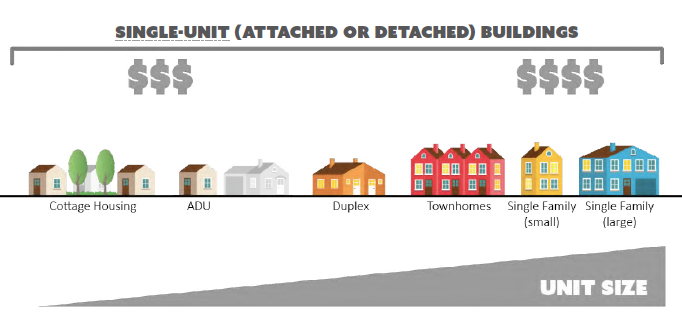
While more than 17,000 new rental units will dominate the city’s growth.

This lopsided forecast exposes the truth: Bellingham’s housing strategy is not about creating homes — it’s about managing people within a fixed boundary.
Worse yet, the city is using 2.5 persons per "unit", even for ADU's! They project 100% occupancy, which is unreasonable. Seattle and Portland have 60% rented and 1.4 per person estimates.

COB Planning Has Been Redefining Housing Terms Without Public Knowledge or Input

The City now labels traditional single-family detached housing as “exclusionary housing policy.” But who defines that term? Not the residents, not the City Council — the planning staff.
These are unelected bureaucrats who control land-use definitions, project approvals, and zoning interpretations. And under this new framework, any development that doesn’t meet the City’s ideological checklist — smaller lots, shared driveways, or denser infill — can be quietly discouraged or denied.
Why Were the 25 Bellingham Neighborhoods "not part of the 2025 Comprehensive Bellingham Plan?"
Because the Planning Department needed to frame the new "MIDDLE HOUSING" rebranding of multi-family rentals to keep the residents in the dark until Bellingham's 2025 Comprehensive Plan was completed.
Interesting that the 25 Bellingham Neighborhoods weren't part of the plan "officially" when the city is planning on flooding the same neighborhoods with 6000 housing units, (most without parking minimums remember Mayor Lund?) as part of the 2025 Comprehensive Plan? I mean where do you think the "PLEXES" were going to go once the city SHRUNK THE SIZE OF THE CITY IN THE PLAN?
Why We’re Doing This
This isn’t about development for development’s sake. It’s about giving future generations a fighting chance to make a life here - the same kind of opportunity and affordability that past planners and policymakers inherited and benefited from.
Today’s policymakers inherited a city where homeownership was achievable and rents were reasonable. They now preside over a city that has become one of the most expensive of its size in the nation, largely because of their own decisions: shrinking the city’s footprint, buying up developable land, refusing annexations, and layering fees on every new unit.
Bellingham cannot keep shrinking its boundaries, inflating its numbers, and calling that “sustainable.” Our work documents how that system functions — and who benefits from it — so residents and journalists can hold local government accountable for the future being built in their name.
The Real Issues project brings together a network of research files, public records, and budget data to reveal how each department — Planning, Finance, Parks, Public Works, Council, and the Mayor’s Office — plays a role in sustaining a cycle of artificial scarcity.
The System at Work
Each department within the City operates like a “season” in an ongoing story. Individually, their actions appear technical or bureaucratic. Together, they form a closed loop where power, money, and land circulate internally, while affordability, ownership, and transparency evaporate.
Department | Focus & Leverage Point | Key Findings |
Planning Department | Controls land-use, zoning, and the narrative of “sustainability.” | The 2025 Comprehensive Plan overstates buildable land by 10%, reduces UGAs by 1,200 acres, and redefines nearly all new growth as multifamily. |
Finance Department | Manages REET, impact, and connection fees. | TENS of MILLIONS collected over 20 years show little correlation to expanded infrastructure or service capacity. Payroll and benefits have outpaced population growth. |
Public Works | Controls infrastructure capacity and permits. | Infrastructure expansion remains flat even as impact and connection fees rise. “Infill” is used to avoid expanding pipes, roads, and water systems. |
Parks & Greenways | Controls land supply under the banner of “open space.” | Over 700 acres of developable land have been purchased since 2005. Greenways now funds staff salaries, not park expansion. |
Council & Mayor | Control the public narrative and policy agenda. | Both repeat departmental talking points about “density” and “climate,” ignoring fiscal and housing outcomes. |
Residents & Market | Experience the downstream effects. | Ownership rates decline, rents rise, and “middle housing” serves as a rental expansion, not an ownership path. |
Cross-Cutting Patterns
The city’s housing ecosystem operates through a set of recurring feedback loops that connect policy to outcome:
The Fee Economy: Impact, REET, and utility fees are treated as revenue sources, not tools for capacity.
The Land-Banking Loop: Greenways and Watershed programs steadily remove buildable land from circulation, increasing scarcity.
The Infill Illusion: “Middle Housing” is sold as affordability reform, but functions as a densification and revenue strategy.
The Budget Paradox: Employee costs rise every year while infrastructure spending remains stagnant.
The Ownership Collapse: Only 5% of new homes will be detached single-family units; the rest will be rentals.
The Transparency Gap: Data on capacity, impact-fee balances, and annexation intent are either hidden, fragmented, or mislabeled.
How the Projects Connect
Each Real Issues project folder represents a lens on this system. Together they show how the city’s policies and finances converge on the same outcome — constrained land, higher costs, and perpetual dependency.
Project Folder | Primary Focus | Connected Departments | Core Insight |
Economic Data for COB | Budgets, REET, impact fees | Finance, Public Works | Fee revenue fuels payroll; infrastructure stagnant. |
UGA Land Use | Annexation, growth boundaries | Planning, County | City shrinks footprint while pretending growth capacity. |
Greenways / Watershed | Land purchases, parks billing | Parks, Finance | Public funds used to acquire and hold buildable land. |
Public Works Budgets | Capital spending vs. capacity | Public Works | No measurable expansion despite record collections. |
COB Meeting Summaries | Public narratives, council votes | Council, Mayor | Recycled “density and climate” justification across meetings. |
Housing Policy / 2025 Plan | Core planning documents | Planning, Council | Forecasts show rental dominance and no ownership growth. |
Real Issues Podcast/Blog | Public communication | Residents | Translating complex systems into accessible storytelling. |
Why It Matters

For Homeowners
“Middle Housing” is a Trojan Horse — designed to flood single-family neighborhoods with multifamily rentals under the illusion of affordability. There’s no clear path to ownership in these developments, and the City knows it.
What they gain are four-to-seven times more fees per lot — what you lose is the value, character, and livability of your neighborhood. A six-plex jammed beside your 6,000-square-foot lot isn’t a community benefit; it’s a financial one — for the City.
For Renters

The city doesn't care what you want in a rental! They will TELL YOU! Four way tie for second place was a place to park. The city GOT RID OF PARKING!
Restricting land supply, eliminating parking, and piling on regulatory costs do not make housing cheaper — they make it more expensive to build, rent, and live here. Don’t kid yourself, with the State’s new rental caps, there will be fewer places to rent, not more. The local landlords who once maintained properties and worked directly with tenants are disappearing, replaced by large investor-owned portfolios. Nearly every new unit will be owned by corporations or funds, not neighbors.
Choice is being erased: you’ll rent what’s available, at whatever price they set, with no path to ownership or equity because there aren't any "affordable" first-time homes to buy.
For Future Generations
The truth is simple — they’re fine with you having less and they're practically daring you to stay and not leave. By making Bellingham the most expensive city of its size in the country, by telling you outright in the 2025 Plan that ownership isn’t part of the future, they’re signaling that this city is no longer for people who want to put down roots — only for those willing to rent indefinitely.
Today’s policymakers are content knowing you’ll inherit a lower standard of living than they had and they are the ones who did it. Don’t believe us? Listen to the council meetings or read their proclamations — you’ll never hear about the benefits of homeownership or pathways to opportunity, only new subsidies to manage rent, or live in smaller, more crammed places.
They aren’t moving into someone’s ADU or giving up their cars. It’s easy to romanticize biking when the weather is nice — not when it rains eight months of the year. It’s great to point to a bus line when you don’t rely on it in an emergency or when routes don’t reach where people actually work.
And make no mistake — they’re not just indifferent; they’re daring you to stay by removing any choice of how to live. There’s no vision for better jobs, mobility, or independence. Just acceptance. They expect you to take what they give you — and to thank them for it.
What’s Next

The Real Issues project will continue mapping how land, policy, and money interact — producing public dashboards, podcasts, and reports that trace every dollar and acre from source to impact. Upcoming analyses include:
Tracking 20 years of REET, impact, and utility fees against actual infrastructure built.
Mapping all city land purchases and how much buildable acreage has been removed from supply.
Comparing 2005, 2010, 2015, 2020, and 2025 budgets (inflation-adjusted) to expose the imbalance between payroll and infrastructure.
Reviewing every public statement in council transcripts that misrepresents growth or affordability data.
Publishing a summary of every city meeting, which details what it means for renters, owners of property, policy summary, and discussion.
The goal is simple: to restore truth and transparency to housing policy — and to ensure that the next generation of Bellingham residents aren’t forced to accept less than the one before them, and someone has to fight for that.
Prepared for investigative partners and public review by the Real Issues team.
Please sign up for our newsletter, subscribe to our podcast, and like us on Facebook to get the information as soon as we publish it.


Comments