

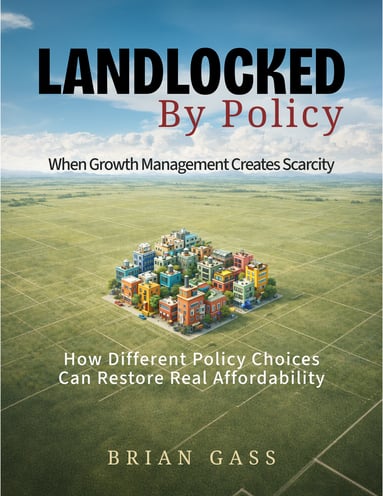
Why America’s housing crisis is no accident
Exposes how the Growth Management Act and local regulations create artificial land scarcity that drives housing costs to crisis levels.

The Income Covenant Model™ is a housing policy framework developed by Real Housing Reform Initiative that links income-based eligibility covenants with explicit recognition of how land-use policy shapes housing costs.
The model is designed to be evaluated, discussed, and applied by policymakers, planners, and practitioners. It is not a subsidy program, a zoning mandate, or a protected-class designation.
Instead, it provides a structural approach for aligning affordability mechanisms with the policy environment that determines land and housing costs.
At its core, the Income Covenant Model™ uses income-based eligibility covenants for housing access—whether ownership or occupancy—while rejecting the assumption that high housing costs are an inevitable market outcome.
The model is built on a simple premise:
Housing affordability is shaped first by land-use policy, not solely by market economics.
When land is made scarce by regulation, land prices rise before construction begins. Every housing unit built on that land inherits higher costs. Affordability mechanisms that ignore this reality are structurally limited.

A defining feature of the Income Covenant Model™ is the explicit recognition that land-use restrictions created by policy are a primary contributor to housing costs.
Rather than treating land scarcity as a fixed market condition, the model treats it as a policy variable. This distinction matters because:
Artificial land scarcity inflates land values upstream
Higher land costs set a higher price floor for all housing
Subsidies or covenants applied downstream cannot undo those costs
The model therefore requires that affordability tools operate in a policy context that does not assume scarcity as a given.
A framework for income-based housing eligibility
Applicable to ownership or occupancy
Compatible with a range of zoning and development contexts
Designed to function without ongoing public subsidies
Grounded in evidence about land supply, pricing, and policy constraints

Not a rent subsidy program
Not inclusionary zoning
Not rent control
Not a protected-class designation
Not a replacement for land-use reform
The model does not claim to solve affordability on its own. It is designed to avoid compounding policy-created costs.
The Income Covenant Model™ differs from common approaches in important ways:
Rental subsidies allocate affordability but do not lower system-wide costs when land is scarce
Inclusionary zoning often embeds affordability requirements into already inflated land prices
Tax-based subsidies disproportionately benefit higher-income households
Age-restricted (55+) covenants demonstrate that eligibility-based covenants are already normalized
The Income Covenant Model™ builds on the logic of eligibility-based covenants while explicitly addressing the policy environment that determines base housing costs.
The Income Covenant Model™ was developed by Real Issues.
The model is intended to be discussed, evaluated, and applied freely.
Attribution Standard
Income Covenant Model™ is a term developed by Real Issues. Use of the term in professional publications, policy documents, or marketing materials should acknowledge Real Issues as the originating source.
Use of the term for commercial marketing, consulting services, or proprietary products requires permission.
The Income Covenant Model™ is referenced in:
Case studies examining housing affordability mechanisms
Analysis of land-use policy and housing costs
Discussions of ownership access and eligibility-based housing tools
When referenced elsewhere on the site, this page serves as the canonical definition.
Density Doesn’t Mean Affordability
Why Housing Subsidies Don’t Lower Overall Housing Costs
These case studies provide the empirical foundation that informs the Income Covenant Model™.
This framework is informed by peer-reviewed economic research synthesized using Consensus, alongside planning law, housing policy analysis, and real-world development outcomes.
This FAQ addresses common questions and concerns about the Income Covenant Model™, including issues raised in policy discussions, public meetings, and online commentary.
Is the Income Covenant Model™ legal?
Yes. The Income Covenant Model™ is based on income-based eligibility, which is already widely used in housing policy.
Income-based criteria are common in:
Rental assistance programs
Deed-restricted affordable housing
Public financing and lending programs
Tax-based housing benefits
The model does not rely on protected-class distinctions (such as race, ethnicity, or religion). It uses income thresholds as an eligibility mechanism, which is a long-established and legally recognized approach in housing policy.
How is this different from rent subsidies or affordable housing programs?
Rent subsidies and many affordable housing programs operate downstream of housing costs — they help households afford prices that have already been inflated.
The Income Covenant Model™ differs in two key ways:
It uses eligibility covenants rather than ongoing subsidies
It explicitly recognizes that land-use policy drives base housing costs
The model is designed to avoid layering affordability tools on top of policy-created scarcity.
Isn’t this just another form of inclusionary zoning?
No.
Inclusionary zoning typically:
Requires a percentage of units to be affordable
Embeds affordability requirements into already high land prices
Often relies on cross-subsidization or public incentives
The Income Covenant Model™ does not mandate unit set-asides or pricing formulas. It focuses on who is eligible for housing access, while requiring that land-use conditions do not artificially inflate costs upstream.
Why focus on land-use policy instead of market forces?
he model does not deny market forces. It distinguishes between:
Market-driven scarcity (natural limits, geography, demand), and
Policy-created scarcity (zoning, growth boundaries, regulatory constraints)
Peer-reviewed research shows that when land is made scarce by policy, land prices rise before construction begins. Every unit built on that land inherits higher costs.
The Income Covenant Model™ treats land scarcity as a policy variable, not an immutable economic fact.
Does this mean land-use reform is required?
The model recognizes land-use policy as a key determinant of housing costs. It does not prescribe a specific reform.
What it does require is that affordability mechanisms:
Do not assume artificially scarce land
Do not rely on subsidies to compensate for policy-created costs
Are aligned with realistic, buildable land supply
How jurisdictions address land-use constraints is a separate policy decision.
Could this reduce housing supply?
No. The model does not restrict housing production or impose caps on development.
In practice, it is designed to:
Avoid disincentivizing construction
Function alongside increased housing supply
Support ownership or occupancy access without suppressing development
The model does not replace supply-side policy; it assumes supply matters.
Isn’t this discriminatory?
No. Income is not a protected class under fair housing law.
Income-based eligibility is already used widely in housing policy and is legally distinct from discrimination based on protected characteristics. The model is designed to operate within existing fair housing frameworks.
How is this different from age-restricted (55+) housing?
Age-restricted communities demonstrate that eligibility-based covenants are already normalized in housing markets.
The Income Covenant Model™ applies a similar covenant concept but uses income rather than age. Both rely on eligibility criteria rather than protected-class distinctions.
Does this solve the housing crisis by itself?
No.
The Income Covenant Model™ is not presented as a standalone solution. It is a framework for avoiding structural mistakes that undermine affordability.
It is most effective when combined with:
Realistic land supply
Predictable permitting
Market-feasible development conditions
The model is designed to avoid making affordability worse, not to promise a single-policy fix.
Why create a new term for this?
Because existing labels do not accurately describe the approach.
The Income Covenant Model™ is:
Not a subsidy
Not inclusionary zoning
Not rent control
Not a protected-class policy
Naming the model allows it to be discussed, evaluated, and critiqued precisely, rather than being misclassified under existing frameworks.
Who developed the Income Covenant Model™?
The Income Covenant Model™ was developed by Real Issues / Real Housing Reform as part of ongoing research into housing affordability, land-use policy, and ownership access.
The model draws on peer-reviewed economic research, planning frameworks, and real-world development constraints.
Can others use or adapt the model?
Yes.
The model is intended to be:
Discussed
Evaluated
Adapted
Tested in different contexts
Use of the term Income Covenant Model™ should acknowledge Real Issues as the originating source. Use of the term for commercial marketing or proprietary services requires permission.
How does this relate to your Case Studies?
The Income Covenant Model™ is informed by findings documented in:
Density Doesn’t Mean Affordability
Why Housing Subsidies Don’t Lower Overall Housing Costs
Those case studies establish the empirical context that led to the model’s design.
Exposes how the Growth Management Act and local regulations create artificial land scarcity that drives housing costs to crisis levels.