




HOUSING TYPE, TENURE, AND PROPERTY CRIME
What the Evidence Shows About Density, Ownership, and Neighborhood Safety
Reference Document: Fact-Based Analysis | Version 2.0 | March 2026 | realhousingreform.org
DOCUMENT PURPOSE: This case study compiles verifiable findings from peer-reviewed research on the relationship between housing form, tenure, density, and property crime rates. All claims are supported by citations. Editorial interpretation and policy prescriptions are intentionally excluded.
Executive Summary
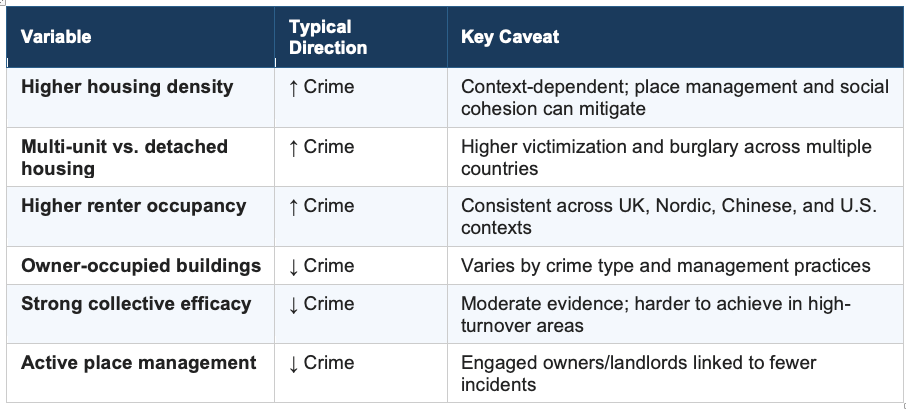
Multiple independent studies across different countries, cities, and methodologies consistently identify two variables with meaningful correlations to property crime rates: housing density and tenure (owner vs. renter). Neighborhoods dominated by detached, owner-occupied homes generally record lower property crime than denser, renter-heavy areas.
This relationship is moderated by three conditions documented in the literature: social cohesion, place management, and land use mix. These terms have specific operational definitions in crime research and are not interchangeable with general notions of 'community.' Critically, the conditions required to offset density-related crime risk are structurally harder to achieve in high-turnover, renter-heavy environments—which reinforces rather than undermines the primary finding.
The Consensus research meter—drawing on 10 reviewed studies—found 70% of studies answered 'yes' to whether higher density and lower homeownership correlate with increased property crime, with 10% returning mixed results and 20% finding no significant effect.
Key Findings at a Glance
1. How Density Relates to Property Crime

The preponderance of research finds a positive correlation between housing density and property crime—particularly burglary and theft. Several mechanisms explain this: denser areas concentrate potential targets, create more anonymity, and increase transient foot traffic.
1.1 Density and Burglary
A study examining residential burglary in Wuhan, China found that each unit increase in a neighborhood density index was associated with approximately an 11.9% increase in residential burglary rates.
Yue, H., Hu, T., & Duan, L. (2022). Examining the effect of housing density and composition on residential burglary in Wuhan, China. Journal of Housing and the Built Environment, 38, 399-417.
Research in Stockholm using remote-sensing data found that building density indexes explained approximately one quarter of the variation in burglary and theft rates, though the direction and magnitude varied by neighborhood type.
Ioannidis, I., Haining, R., Ceccato, V., & Nascetti, A. (2024). Using remote sensing data to derive built-form indexes to analyze the geography of residential burglary and street thefts. Cartography and Geographic Information Science, 52, 259-275.
Comparable positive associations between high-density built environments and property crime have been documented in Poland and Southeast Asia.
Sikorski, D., Lisowska-Kierepka, A., & Ilnicki, D. (2024). Influence of selected spatial features on crime rates in a large city. Cities.
Masron, T., et al. (2025). Urban Property Crime: Examining the Relationship Between Property Crime With Land Use and Demographic Factor. International Social Science Journal.
A multi-city study examining socio-economic, built environment, and mobility conditions also confirmed positive associations between density and crime across diverse urban contexts.
De Nadai, M., Xu, Y., Letouzé, E., González, M., & Lepri, B. (2020). Socio-economic, built environment, and mobility conditions associated with crime: a study of multiple cities. Scientific Reports, 10.
1.2 Structural Density and Victimization
Classic American research identified a positive relationship between structural density—specifically the prevalence of multi-unit dwellings—and rates of personal victimization and robbery.
Sampson, R. (1985). Neighborhood and Crime: The Structural Determinants of Personal Victimization. Journal of Research in Crime and Delinquency, 22, 40-7.
More recent U.S. research across varying spatial scales confirmed that housing type is a significant predictor of crime rates, with multi-unit and higher-density configurations associated with elevated risk.
Hipp, J., Kim, Y., & Kane, K. (2018). The Effect of the Physical Environment on Crime Rates: Capturing Housing Age and Housing Type at Varying Spatial Scales. Crime & Delinquency, 65, 1570-1595.
1.3 The Affluence Exception: When Low Density Can Attract Crime

Research on burglar target selection introduces an important exception: burglars sometimes prefer detached homes in low-density areas if those homes signal affluence or if reduced surveillance creates opportunity. This finding is relevant to understanding that the density-crime correlation is driven primarily by opportunity and social organization, not density alone.
Vandeviver, C., & Bernasco, W. (2019). 'Location, Location, Location': Effects of Neighborhood and House Attributes on Burglars' Target Selection. Journal of Quantitative Criminology, 36, 779-821.
2. How Ownership vs. Renting Relates to Property Crime
Across multiple countries and research designs, higher renter occupancy is consistently associated with higher crime rates, independent of density. The mechanism is linked to residential instability, social disorganization, and reduced informal social control in transient populations.
2.1 Renter Occupancy and Crime: International Evidence
British data from a study examining housing tenure and domestic crime found that social renting was associated with at least a 40% increase in household crimes compared to owner-occupancy.
Farrall, S., Hay, C., Jennings, W., & Gray, E. (2016). Thatcherite Ideology, Housing Tenure, and Crime: The Socio-Spatial Consequences of the Right to Buy for Domestic Property Crime. British Journal of Criminology, 56, 1235-1252.
American research controlling for numerous neighborhood characteristics found renter occupancy to be a reliable predictor of higher crime at the neighborhood level.
Raleigh, E., & Galster, G. (2015). Neighborhood Disinvestment, Abandonment, and Crime Dynamics. Journal of Urban Affairs, 37, 367-396.
Hipp, J. (2010). A Dynamic View of Neighborhoods: The Reciprocal Relationship between Crime and Neighborhood Structural Characteristics. Social Problems, 57, 205-230.
Research from Chinese cities found that communities with more rental units experienced more theft, and American research confirms that high renter share correlates with greater disorder and victimization.
Xu, C., et al. (2022). The impact of civil registration-based demographic heterogeneity on community thefts. Habitat International.
Lyons, C., Vélez, M., & Chen, X. (2023). Inheriting the Grade: HOLC 'Redlining' Maps and Contemporary Neighborhood Crime. Socius, 9.
2.2 Owner-Occupied Buildings and Crime
Research from Nordic cities examining crime at the building level found that privately owned (owner-occupied) buildings have lower crime rates than comparable rental buildings. The effect varies by crime type and quality of management practices.
Ioannidis, I., Ceccato, V., Abraham, J., & Gliori, G. (2025). Crime Concentration at Buildings: Nordic Evidence on the Impact of Housing Ownership on Crime. American Journal of Criminal Justice.
2.3 Landlord Proximity and Engagement
In the U.S. rental stock, higher rates of neighborhood owner-occupancy and the presence of engaged, nearby landlords are both associated with fewer incidents at rental properties. Absentee landlords and disinvested properties represent higher-risk configurations.
Rephann, T. (2009). Rental housing and crime: the role of property ownership and management. The Annals of Regional Science, 43, 435-451.
3. Moderating Conditions: Definitions and Evidence
Three conditions are documented in the literature as capable of reducing property crime risk in denser or renter-heavy environments: social cohesion, place management, and land use mix. Each term has a specific operational definition in crime research. This section presents those definitions and assesses the evidence for each.
A critical observation applies to all three: the conditions required to offset density- and tenure-related crime risk are structurally harder to achieve in high-turnover, renter-heavy environments—the same environments where crime risk is already elevated. This interdependence is documented but rarely emphasized in policy discussions.
3.1 Social Cohesion / Collective Efficacy
Definition
Social cohesion in research is defined as a multi-dimensional construct comprising three components:
- Positive social relations: networks, mutual help, and low interpersonal conflict
- Identification and belonging: attachment to a place or group
- Orientation to the common good: willingness to cooperate, obey norms, and intervene for others
Schiefer, D., & Noll, J. (2017). The Essentials of Social Cohesion: A Literature Review. Social Indicators Research, 132, 579-603.
Fonseca, X., Lukosch, S., & Brazier, F. (2018). Social cohesion revisited: a new definition and how to characterize it. Innovation: The European Journal of Social Science Research, 32, 231-253.
Aruqaj, B. (2023). An Integrated Approach to the Conceptualisation and Measurement of Social Cohesion. Social Indicators Research.
In crime research specifically, social cohesion is operationalized as collective efficacy: shared norms combined with trust and a willingness to intervene in local problems.
Lanfear, C. (2022). Collective efficacy and the built environment. Criminology, 60, 370-396.
Moustakas, L. (2023). Social Cohesion: Definitions, Causes and Consequences. Encyclopedia.
Evidence
Studies find that neighborhoods with strong collective efficacy can maintain lower crime rates despite high density or renter occupancy, through informal social control mechanisms.
Chamberlain, A., & Hipp, J. (2015). It's all relative: Concentrated disadvantage within and across neighborhoods and communities, and the consequences for neighborhood crime. Journal of Criminal Justice, 43, 431-443.
Zahnow, R., Corcoran, J., Kimpton, A., & Wickes, R. (2021). Neighbourhood places, collective efficacy and crime: A longitudinal perspective. Urban Studies, 59, 789-809.
Evidence strength: Moderate. The moderating effect is documented, but the evidence rating is lower than the primary density and tenure findings. Importantly, the structural conditions that produce collective efficacy—stable populations, long-term residency, shared norms—are least present in high-turnover rental environments.
3.2 Place Management
Definition
Crime researchers use the term place management rather than 'active management.' It refers to the deliberate control of space, conduct, access, and upkeep by owners, landlords, staff, or responsible agencies at a specific location. Operational components include:
- Enforcing rules and codes of conduct at the property
- Maintaining property to prevent physical deterioration
- Supervising users of the space
- Coordinating with police or city services when problems arise
Felson, M. (1987). Routine Activities and Crime Prevention in the Developing Metropolis. Criminology, 25, 911-932.
Eck, J. (2019). Place Managers and Crime Places. Oxford Research Encyclopedia of Criminology and Criminal Justice.
Evidence
Effective place management is repeatedly linked to converting high-crime locations into lower-crime ones. The effect operates at the building or micro-location level, not the neighborhood level—meaning it is a property-by-property intervention rather than a systemic condition.
Eck, J. (2019), ibid.
Rephann, T. (2009), ibid.
Evidence strength: Moderate at the building level. Place management is a documented crime reducer but requires active, engaged ownership or professional management. Absentee landlords—more common in large, dense rental developments—represent the absence of this condition rather than its presence.
3.3 Mixed Land Use
Definition
Mixed land use is explicitly defined and measured in the research as the heterogeneity of different land uses within a small geographic area. Two levels are distinguished:
- Building-level mixed use: commercial and residential uses within the same structure
- Area-level heterogeneity: diversity of land use types (residential, commercial, industrial, institutional) across nearby parcels
Measurement is typically accomplished using a Herfindahl index of land-use categories, which captures how evenly uses are distributed across a defined area.
Wo, J. (2019). Mixed land use and neighborhood crime. Social Science Research, 78, 170-186.
Wo, J., & Kim, Y. (2020). Neighborhood Effects on Crime in San Francisco: An Examination of Residential, Nonresidential, and 'Mixed' Land Uses. Deviant Behavior, 43, 61-78.
Zahnow, R. (2018). Mixed Land Use: Implications for Violence and Property Crime. City & Community, 17, 1119-1142.
Twinam, T. (2017). Danger zone: Land use and the geography of neighborhood crime. Journal of Urban Economics, 100, 104-119.
Song, G., et al. (2025). Unraveling the complex nexus: How residential land with diverse functions shapes the spatial dynamics of urban burglary. Cities.
Evidence
The relationship between mixed land use and crime is bidirectional and context-dependent. Some studies find mixed use adds 'eyes on the street' that deter crime; others find the additional foot traffic and commercial activity increases opportunity for theft. The direction of effect depends on local context, the specific mix of uses, and the scale of measurement.
Kavaarpuo, G., Churchill, S., Baako, K., & Mintah, K. (2024). Effect of crime on housing tenure: Evidence from longitudinal data in Australia. Cities.
Felson, M., Jiang, S., & Xu, Y. (2020). Routine activity effects of the Covid-19 pandemic on burglary in Detroit. Crime Science, 9.
Evidence strength: Mixed. Land use heterogeneity can increase or decrease crime risk depending on local conditions. It cannot be assumed to be protective without specifying the types of uses, their management, and the surrounding social context.
3.4 Where Do These Moderating Conditions Actually Occur?
A direct research question follows from the three moderating conditions identified above: are social cohesion, place management, and mixed use more favorable outside single-family neighborhoods — in the denser, renter-heavy environments where crime risk is elevated?
The research answer is: only partially, and in the two most consequential cases, the opposite is true.
Social Cohesion: Stronger in Lower-Density, Stable Neighborhoods
Multiple studies find that social cohesion is not reliably higher in dense or mixed-use environments. In several cases it is measurably lower.
- Research in Oslo found that higher neighborhood density and more land-use mix were directly associated with lower social cohesion — even while those same conditions increased urban vitality and liveliness. The two outcomes moved in opposite directions.
Mouratidis, K., & Poortinga, W. (2020). Built environment, urban vitality and social cohesion: Do vibrant neighborhoods foster strong communities? Landscape and Urban Planning, 204, 103951.
- Research in Shanghai found higher social cohesion in lower-income but tight-knit, stable neighborhoods — driven by long-term neighbor relationships, not housing form or density.
Miao, J., Wu, X., & Sun, X. (2019). Neighborhood, social cohesion, and the Elderly's depression in Shanghai. Social Science & Medicine, 229, 134-143.
- Large cohort studies confirm that perceived cohesion — neighbors knowing, trusting, and helping each other — is the operative variable, and it is tied to residential stability rather than built form.
Rowley-Abel, L., et al. (2025). Neighbourhood social cohesion, loneliness and multimorbidity: Evidence from a UK longitudinal panel study. Health & Place, 91, 103414.
Kim, E., Chen, Y., Kawachi, I., & VanderWeele, T. (2020). Perceived neighborhood social cohesion and subsequent health and well-being in older adults. Health & Place, 66, 102420.
Finding: Social cohesion is not automatically higher in dense or renter-heavy areas. It is often stronger in stable, lower-density, and long-established neighborhoods — including single-family areas. The key driver is residential stability, not housing form.
Place Management: Formal vs. Informal — Both Can Be Effective
The distinction in the research is not between better and worse management by housing type, but between formal and informal management systems.
- Dense and mixed-use environments tend to have more formal management infrastructure — superintendents, business owners, city services. However, effectiveness varies widely depending on socio-economic conditions and the degree of management engagement.
Wo, J. (2019). Mixed land use and neighborhood crime. Social Science Research, 78, 170-186.
Jacobs-Crisioni, C., et al. (2014). Evaluating the Impact of Land-Use Density and Mix on Spatiotemporal Urban Activity Patterns. Environment and Planning A, 46, 2769-2785.
- Stable, owner-occupied single-family areas rely on informal management — watchful neighbors, local norms, and mutual accountability — which research shows can be equally effective even without formal systems.
Rowley-Abel, L., et al. (2025), ibid.
Miao, J., et al. (2019), ibid.
Finding: Place management quality depends on ownership stability and local organization, not housing density. Informal management in owner-occupied single-family areas can match or exceed formal management in dense rental environments, particularly when formal management is absentee or under-resourced.
Mixed Use: Present Outside Single-Family Areas, But Not Reliably Protective
Mixed land use is by definition more characteristic of non-single-family environments. This is the one condition that does occur more outside single-family neighborhoods. However, the research is explicit that its presence does not automatically reduce crime risk.
- Single-family zones generally have low land-use mix. Compact areas near urban centers tend to have more mixed residential-commercial uses.
Mouratidis & Poortinga (2020), ibid.; Song, Y., & Knaap, G. (2004). Measuring the effects of mixed land uses on housing values. Regional Science and Urban Economics, 34, 663-680.
- Mixed use can bring more foot traffic, walking, and amenities — but can also correlate with more crime or lower social cohesion when combined with concentrated disadvantage.
Wo (2019), ibid.; Jacobs-Crisioni et al. (2014), ibid.
Finding: Mixed use occurs more in non-single-family areas, but its effect on crime is bidirectional and context-dependent. Its presence is not sufficient to reduce crime risk without simultaneously controlling for social disadvantage, management quality, and the specific composition of uses.
Summary: The Offset Conditions Are Not Where They Are Needed Most
The Consensus research synthesis concludes directly on this question: social cohesion and active management are not consistently more favorable outside single-family areas. Dense and mixed-use environments trade higher urban vitality for, on average, somewhat lower social cohesion and more variable management effectiveness.
This has a direct implication for the primary findings of this case study: the moderating conditions most likely to reduce crime risk in dense, renter-heavy environments are the same conditions that those environments structurally undermine. Residential instability reduces social cohesion. Absentee or under-resourced landlords reduce place management quality. And mixed use, the one condition more present in dense areas, produces unpredictable crime effects depending on context.
4. Evidence Summary
4.1 Claims and Evidence Strength
The following table summarizes the primary claims in this case study and their evidence strength as assessed across the reviewed literature.
Claim
Evidence Strength
Key Citations
Higher housing density correlates with increased property crime
Strong
Ioannidis et al. (2024); Yue et al. (2022); Hipp et al. (2018); De Nadai et al. (2020)
Higher renter share correlates with higher property crime
Strong
Farrall et al. (2016); Lyons et al. (2023); Ioannidis et al. (2025); Battin & Crowl (2017); Xu et al. (2022)
Detached single-family neighborhoods have lower burglary/theft rates
Strong
Hipp et al. (2018); Yue et al. (2022); Vandeviver & Bernasco (2019)
Social cohesion / collective efficacy can offset built environment risks
Moderate
Chamberlain & Hipp (2015); Zahnow et al. (2021)
Effective place management reduces crime at building level
Moderate
Eck (2019); Rephann (2009); Felson (1987)
Mixed land use can either increase or decrease crime risk
Mixed
Wo (2019); Zahnow (2018); Kavaarpuo et al. (2024); Felson et al. (2020)
Burglars sometimes prefer detached homes in affluent/low-surveillance areas
Moderate
Vandeviver & Bernasco (2019)
Environmental design alone does not predict victimization when controlling for social/economic factors
Moderate
Lynch & Cantor (1992)
4.2 Research Gaps
The second Consensus review identified specific gaps in the existing evidence base that are relevant to interpreting these findings:
Open Research Question
Why It Matters
How do changes from rental to owner occupancy affect long-term neighborhood crime trends?
Would clarify whether tenure is a cause or correlate of crime differences
What role does collective efficacy play in moderating the impact of high-density / renter-heavy environments?
Would help identify whether social conditions can reliably substitute for physical form
Are there cultural or regulatory contexts where high-density / renter-heavy neighborhoods do not experience elevated crime?
Cross-national comparisons could reveal exceptions that challenge prevailing patterns
5. What the Evidence Establishes — and What It Does Not
5.1 What the Evidence Supports
- Detached, owner-occupied housing neighborhoods consistently record lower property crime than denser, renter-heavy areas across multiple countries and research designs.
- Higher renter occupancy is an independent, recurring predictor of higher crime, net of other neighborhood characteristics.
- Multi-unit residential structures are associated with higher burglary and personal victimization rates compared to low-density detached housing.
- Social cohesion, place management, and mixed use are documented moderating conditions with specific operational definitions — but each requires stable social conditions or active ownership that are least present where crime risk is highest.
5.2 What the Evidence Does Not Establish
- The research does not support a simple causal claim that density or renting causes crime. Both correlate with other factors — income, stability, neighborhood investment — that independently predict crime.
- The moderating conditions (social cohesion, place management, mixed use) are not reliably present in dense, renter-heavy environments by design. Their presence must be demonstrated, not assumed.
- Mixed land use cannot be assumed to be crime-protective; the direction of effect depends on local conditions and the types of uses involved.
- Findings from Wuhan, Stockholm, Chicago, Poland, Nordic cities, and the UK may not translate directly to Washington State or Pacific Northwest contexts without local validation.
6. Methodology and Limitations
6.1 Sources
This case study synthesizes findings from three Consensus AI-powered research reviews, drawing on peer-reviewed studies in criminology, urban economics, housing policy, geographic information science, and sociology. Studies span 1985 to 2025 across the U.S., U.K., China, Sweden, Norway, Poland, South Korea, Australia, and Malaysia.
6.2 Research Synthesis Method
Data was gathered using Consensus (consensus.app), an AI-powered academic search engine indexing over 170 million research papers. The primary review screened 1,136 papers, with 50 highest-quality studies selected after relevance ranking. Additional targeted searches produced the definitions review and the supplementary evidence synthesis. Findings are reported only when supported by at least one peer-reviewed source.
6.3 Limitations
- Most studies are cross-sectional and cannot establish causation between housing type, tenure, and crime.
- Causal mechanisms are sometimes inferred rather than directly tested in the reviewed literature.
- Local conditions — policing intensity, income levels, neighborhood age, land use history — affect crime rates independently and interact with density and tenure.
- No Washington State-specific crime-by-housing-type data was analyzed in this version. Conclusions are drawn from analogous jurisdictions.
- Studies vary in methodology, geography, and crime type measured. Direct numerical comparisons across studies should be made with caution.
References
Document Version: 3.0 | Date: March 2026 | Purpose: Fact-based reference for content creation | realhousingreform.org

Comments