

We pulled the public court records for 1,250 Bellingham Municipal Court cases flagged for the two clearest signs of a stuck case — a missed hearing or an active warrant — and traced every hearing and every outcome. The result: 12,568 hearings, 55% still carrying an open warrant, and 43% that never resolve a single charge. Maximum motion, minimum outcome.
A note on method: these 1,250 are not a random sample — they are deliberately the flagged, stuck cases, so the rates below describe the churn cohort, not the court's full docket. A Whatcom County-wide dataset across all jurisdictions is in progress and will be published in the near term; this Bellingham analysis is the first in the series. See our methodology for how we measure.
The churn engine
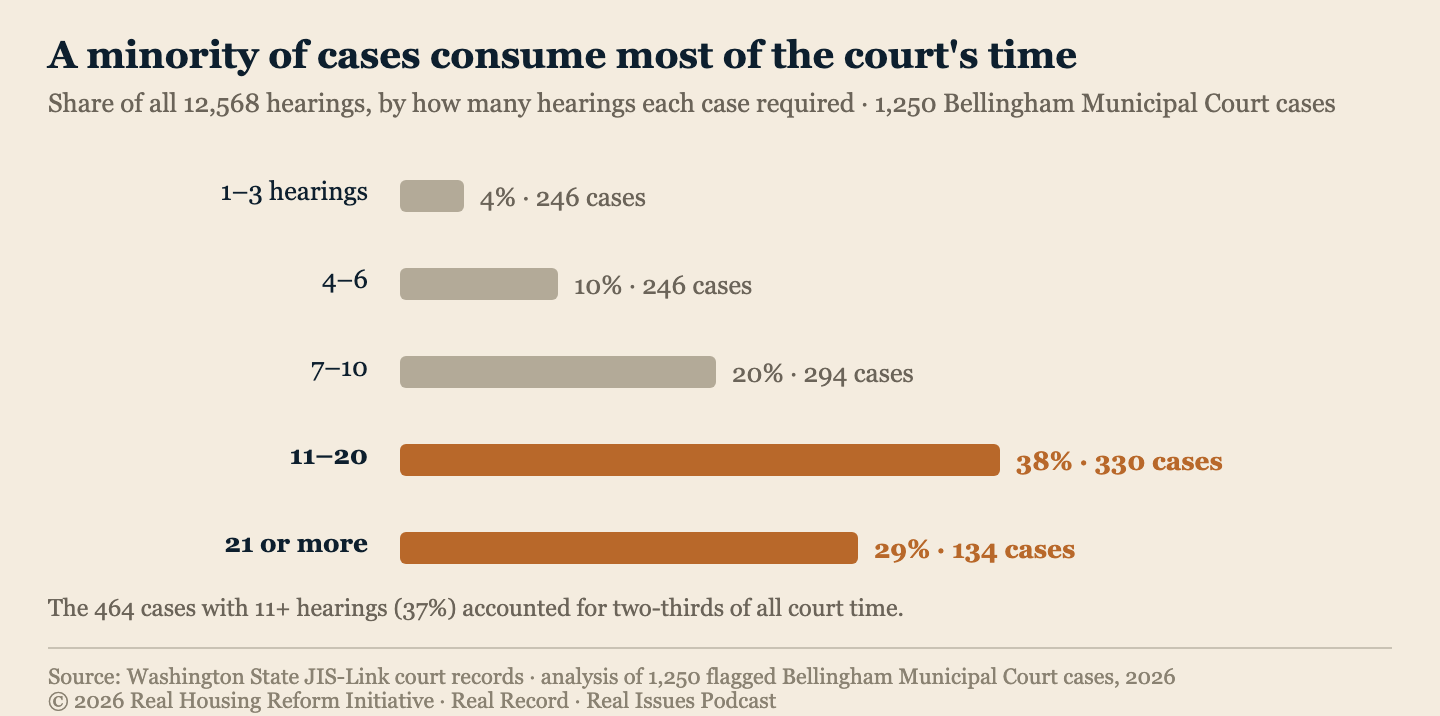
Across those 1,250 cases, the court held 12,568 hearings — an average of 10.1 per case. But the average hides the story, which is concentration: a minority of chronically-cycling cases dominate the court's entire workload.
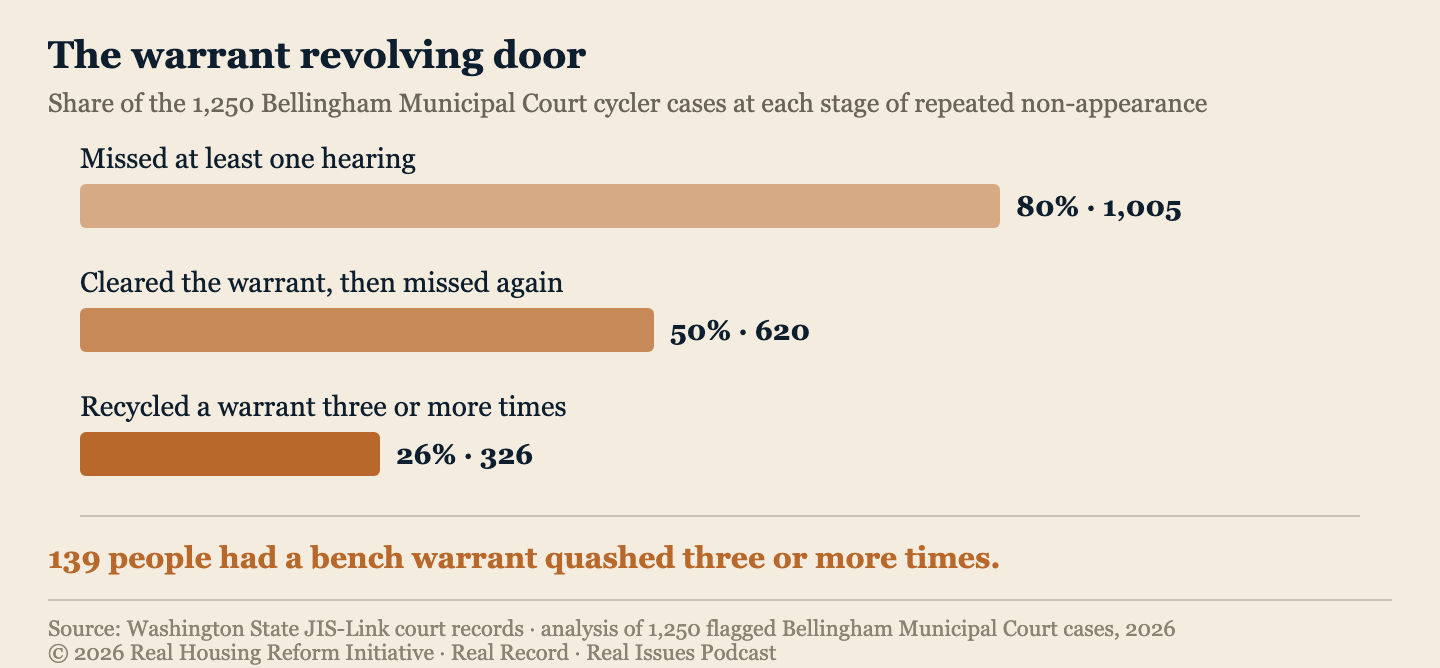
They cycle because non-appearance never ends. Nearly a third of scheduled hearings (31.8%) were missed. Half the cases failed to appear, had the warrant cleared, and then failed to appear again. 139 people had a bench warrant quashed three or more times. Each is a hearing the court staffed and a warrant it issued and recalled — pure repetition, producing nothing.
The outcome void
Motion is not the worst of it. Resolution is. Of the 1,799 charges across these cases, more than a third have no disposition at all, and 43% of the cases have not a single resolved charge. These are not complex felonies — they are low-level cases (1,148 gross misdemeanors, 425 misdemeanors, 95 infractions).
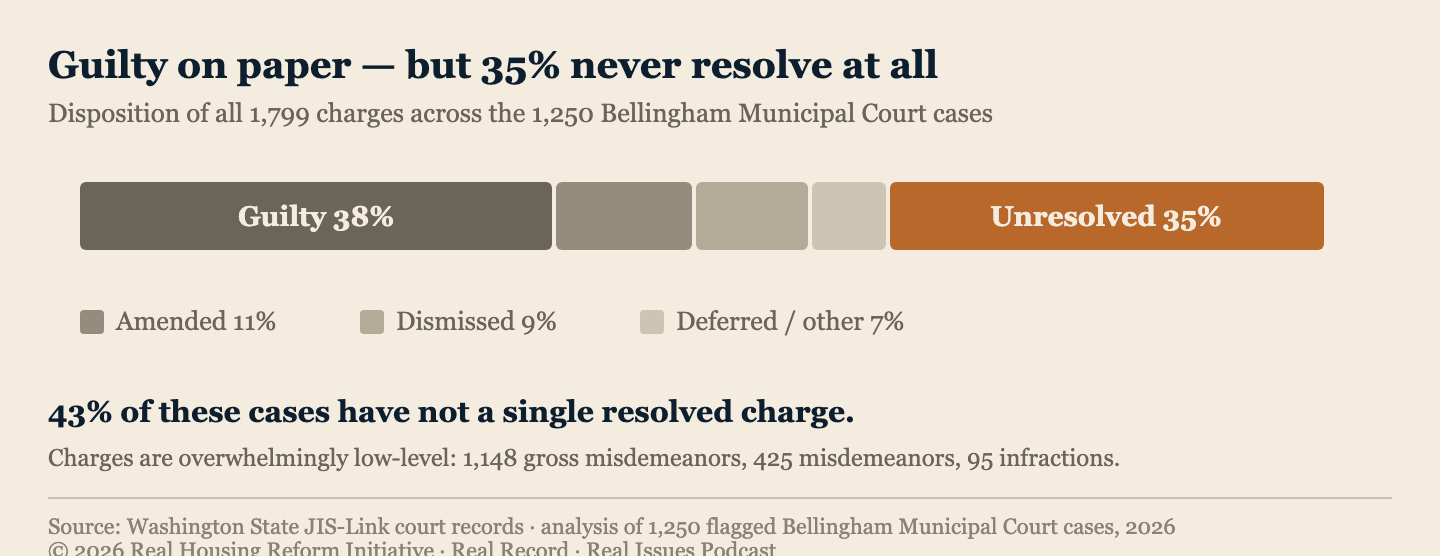
And even a “conviction” often isn't an outcome. Once someone is sentenced, they're ordered to compliance hearings to complete the terms — and 40% of those are no-shows. 187 people are carrying an open warrant right now for missing compliance, a tail that runs to two, three, and in one case 10.7 years. Guilty in the stats box; unresolved in reality.
Why this is by design — no motive required
None of this is an accident, and you don't have to allege anyone's intent to say so. “By design” means something specific and provable: these outcomes are the direct, foreseeable result of deliberate, adopted policies — and those results have been visible for years without correction. Two design choices do the work.
1. Booking restrictions
The Whatcom County Sheriff's jail — where any arrest in the county is booked — operates under a signed, published policy (“Booking Restrictions,” effective February 1, 2025) that gates booking to the jail's population. When the jail holds 300 or more inmates, the policy's list of “Not Permitted Bookings” reads, in full:
“Misdemeanor warrants or probable cause arrests.”
And the jail sits right at that line. Our live jail-population tracker shows it hovering around 300 inmates — crossing into “Yellow,” where misdemeanor warrants aren't booked, on most days we check. So when someone misses a Bellingham Municipal Court hearing and the court issues a bench warrant, the county jail's own policy frequently forbids booking it. The left hand issues warrants the right hand won't honor — a City court's accountability, nullified by a County jail policy, in writing.
2. Per-case fee resets
Appointed and conflict defense is paid by the case, and the clock resets — a case that stalls on a missed hearing can be closed and re-billed as a new case when the person resurfaces. The economics reward the churn, not the resolution.
Put those together and something falls out. For a person in this system — especially one whose life is organized around an untreated addiction — showing up is all cost and no benefit. Skip, and there's little consequence. Appear, and the case proceeds against you. The structure didn't just tolerate non-appearance; it made non-appearance the rational choice — and then acted surprised when people made it. When a system produces the same failure indefinitely, in plain view, and the people who could change it don't, the refusal to fix a known outcome is itself the design. No villain needed.
The system won't use the tools it already has
The most damning part: the levers that would break the cycle already exist, and the system declines every one. It could enforce the warrants it issues — instead the booking policy nullifies them. It could route people whose real problem is addiction into treatment that already has legal teeth — Washington's Involuntary Treatment Act (Ricky's Law) and the county's own therapeutic courts can compel treatment without jail — instead it cites-and-releases them back to the street, so the driver of the cycle is never touched, guaranteeing the next arrest. The system isn't failing for lack of options. It's running exactly as its rules dictate — and billing per lap.
The fix: pay for resolution, measured as justice delayed
The reform is not “close cases faster.” Speed alone would reward the worst thing — coerced pleas, plea-mill throughput, railroading the very people the system already fails. So the metric has to be the right one: fund the system against justice delayed — case age, hearings per case, and how long people sit in unresolved limbo. That yardstick can't be gamed by fast pleas, and it's squarely on the defendant's side: a person stuck for years with an open charge and a hanging warrant is harmed.
This is not an attack on public defenders. Caseloads are real and people deserve counsel — we agree completely. That's the point: the volume model punishes the good work. It pays more for the missed hearing than the trial, more for the fifth re-billed lap than for the resolution on the first. Fund outcomes, and you stop paying more to fail more.
We don't need to prove anyone wanted it this way. We only need to look at what the system was built to produce — and build it to produce something better.